
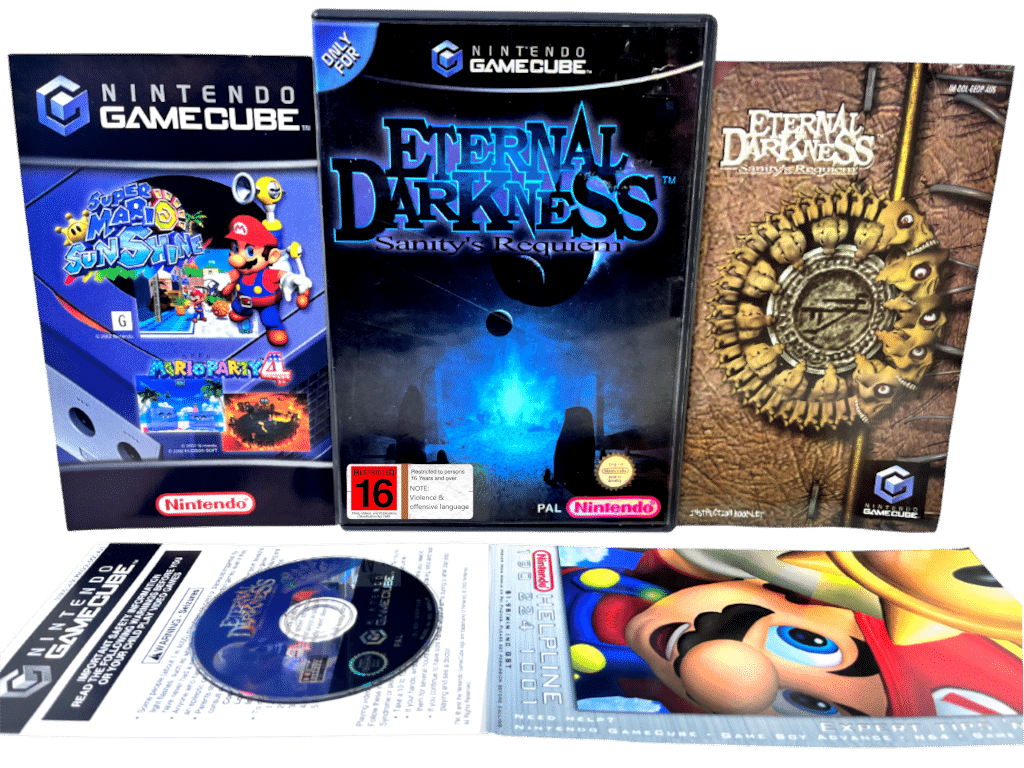
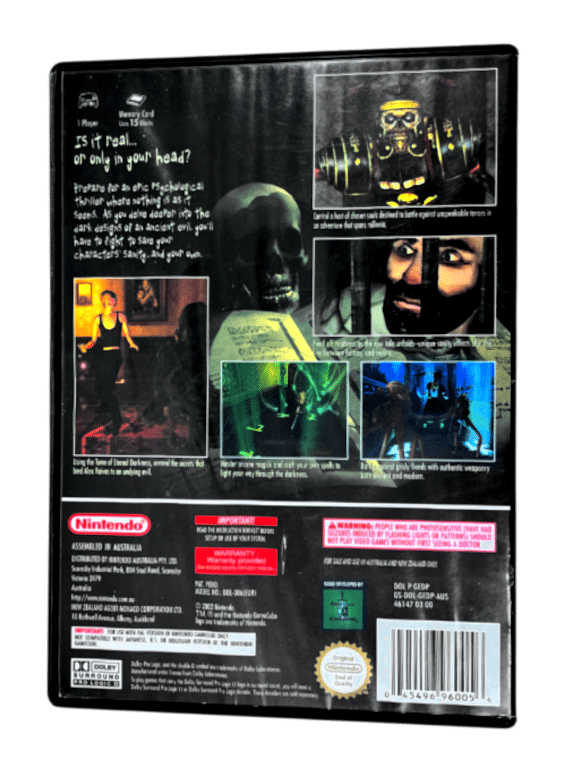

Eternal Darkness: Sanity’s Requiem (GameCube) *MINT COMPLETE*
$99.99
Out of stock
Want to be notified when this product is back in stock?
Description
Genuine NZ Print (PAL Edition) in excellent condition & 100% complete with contents: ETERNAL DARKNESS SANITY’S REQUIEM for Nintendo GameCube. This preowned game is in superb condition and complete with case, cover, manual / booklet, PAL Region game disc, GameCube Catalogue, and Gamecube carded insert. Light wavy lines in the paper cover (NOT paper creases), but these are purely cosmetic. A tidy and complete collector’s item.
Follow Appleby Games on Facebook & Instagram for Free $20 Vouchers for every $200 spent with our Loyalty Programme, product updates, competitions, and find our store opening hours on Google.
Eternal Darkness: Sanity’s Requiem is an action-adventure video game developed by Silicon Knights and published by Nintendo for the GameCube in 2002. It was produced and directed by Denis Dyack. The game follows the story of several characters across a period of two millenia and four different locations on Earth, as they contend with an ancient evil who seeks to enslave humanity. The gameplay distinguishes itself with unique “sanity effects”, visual and audial effects that confuse the player and often break the fourth wall.
Gameplay
The game is conducted from a third-person perspective. It has an in-game map which tracks the player’s bearings. The inventory system stores weapons and items that can be used to solve puzzles, some of which can be combined with other objects, even enchanted with magick, for different effects.
Combat focuses on a simple targeting system. Players may attack in a general direction, or lock-on to an enemy to focus on individual parts of its anatomy. Decapitating most enemies effectively blinds them. There are many classes of enemies the player must either defeat or avoid. Each class also comes in a few varieties, and subtle differences between each variety exist as well, having slightly different appearances and traits. Some of the more common enemies vary very little in appearance, usually only changing in hue and aesthetics, but may have some behavioral differences. Boss and mini-boss enemies, however, tend to vary quite significantly.
The narrative of the game’s story switches between two phases. The main phase focuses on a series of chapters in which players take control of a new character each time. The other phase acts as an intermission, exploring the mansion in order to find chapter pages and other items in order to progress. The game boasts twelve playable characters, split between four distinct locations, and from different periods of time, at times in anachronic order. Each of these characters are different in terms of the game’s three main parameters – health, sanity, and magick – and have access to a small selection of weapons that they can use in combat, though what they can use is determined by the time period that they lived in. For example, characters from the more ancient eras are restricted to mostly melee weapons such as swords, with the occasional crossbow or throwable. Meanwhile, characters from the colonial era onwards have more access to ranged weapons, including modern-day firearms.
The story features multiple paths that can be taken at the end of the first chapter. This choice not only determines which of the game’s other three antagonists are aligned to the plot, but it also has subtle effects on the gameplay in chapters and intermission periods. Some changes include slight differences in puzzles and items, but most changes revolve around enemy placement, which will determine how the player engages them. This can even have an effect on the relative difficulty of the game in certain situations. Red tinted enemies for example, are generally tougher, having more health and dealing more damage, making that story path a kind of unofficial hard mode. After the game is completed down one path, it becomes unavailable in future playthroughs, until the player completes all three paths.
The crafting menu allows the player to experiment and discover new spells.
Magick can be used by most characters and consists of spells that can be used to damage opponents, protect characters and heal them, and be used to solve certain puzzles. The player is also able to assign spells to buttons for quick-use during the game. After discovering a spell it can be used in subsequent chapters and intermission periods. All spells are fundamentally affected by what alignment rune is used to power them. The game incorporates four types – Red, Green, Blue, and Purple. Each alignment affects spells on a specific parameter. On top of that, they operate on a rock-paper-scissors principle of gameplay. All spells require the player to combine a series of Runes together in order to cast them. Runes can be freely experimented with by the player. This robust mechanic of experimentation has been praised by game critics as unique, and something that sets the magick system in this apart from most magic systems of most other game titles.
The other distinctive gameplay aspect comes from “Sanity Effects”, the game’s standout concept that Nintendo patented.[2] Upon beginning the game’s second chapter, players must keep watch on a Sanity meter – a green bar which decreases when the player is spotted by an enemy. As the bar becomes low, subtle changes to the environment and random unusual events begin to occur, which reflect the character’s slackening grip on reality.[3]
Minor effects include a variety of things, such as a skewed camera angle, heads of statues following the character, and unsettling noises. Stronger effects include bleeding on walls and ceilings, entering a room that is unrealistic before finding that the character never left the previous room, or the character suddenly dying. Fourth wall breaking effects such as “To Be Continued” promotions for a “sequel”, and simulated errors and anomalies of the TV or GameCube can happen either from low or depleted sanity, or by a scripted event. While the latter does not affect gameplay, they can be misconstrued by the player as being actual technical malfunctions.
Story
The story of Eternal Darkness takes place over four fictional locations which the game moves between. They include the “Forbidden City” underground temple complex in Persia; a Khmer temple in Angkor Thom, Cambodia; Oublié Cathedral in Amiens, France; and the Roivas Family Estate in Rhode Island, which leads to an ancient underground city named Ehn’gha beneath the mansion. The story moves between these locations, with each chapter occurring during a different time period (between 26 B.C. and 2000 A.D.), and from the perspective of a different character. The chapters in the game are not in chronological order.
Related products
-
 Sale!
Sale!
MARIO PARTY 5 (GameCube) *MINT COMPLETE*
Original price was: $129.99.$84.49Current price is: $84.49.Add to cart -
 Sale!
Sale!
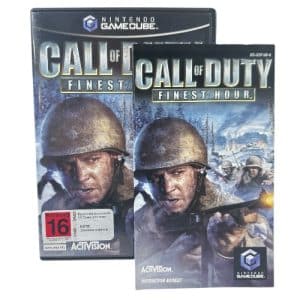
Call of Duty: Finest Hour (GameCube) *MINT COMPLETE*
Original price was: $59.99.$38.99Current price is: $38.99.Add to cart -
Sale!
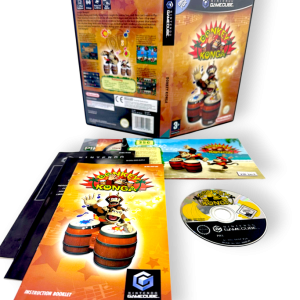
DONKEY KONGA (GameCube) *MINT COMPLETE*
Original price was: $69.99.$45.49Current price is: $45.49.Add to cart -
 Sale!
Sale!

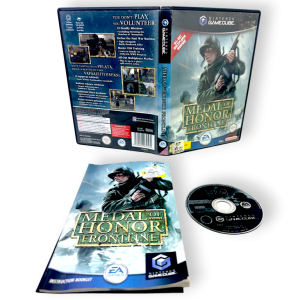
Medal of Honor Frontline (GameCube) *MINT COMPLETE*
Original price was: $39.99.$19.99Current price is: $19.99.Add to cart
Reviews
There are no reviews yet.